
Genetics & Maternal Program
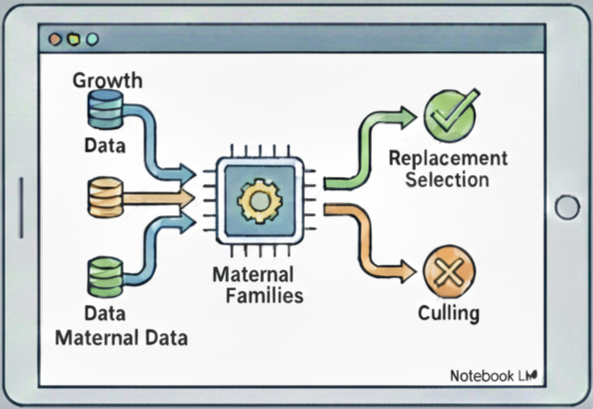
Genetic improvement is a long game, but day-to-day decisions still matter. At the Galena Homestead, our Genetics & Maternal Program is built around a simple principle: EBVs provide long-term genetic direction, while phenotype provides real-time feedback. The most reliable flock improvement occurs when both are blended deliberately and evaluated across maternal families—not individual animals.
This approach produces sheep that perform predictably, generation after generation, under real production conditions.
Genetic Direction: EBVs as a Compass
We use EBVs to establish long-term genetic direction for both growth and maternal performance. EBVs are not used to chase short-term results or rank individual animals in isolation, but to ensure the flock is moving steadily in the right direction over time.
Our program emphasizes a balanced set of growth and maternal EBVs, allowing us to improve efficiency and productivity simultaneously. This balanced approach has produced animals ranking in the top percentiles nationally for combined growth and maternal performance—without sacrificing functional type or system fit.
EBVs help us answer one essential question
Are we moving the flock in the right genetic direction across generations?
Phenotypic Feedback: Evaluating What Shows Up Now
While EBVs guide direction, phenotype provides real-time—but noisy—feedback on how genetics are expressing under actual conditions. Individual records can vary due to environment and management, so phenotype is used as a confirmation tool, not a standalone decision-maker.
Our phenotypic evaluation focuses on outcomes that matter in real flocks:
Ewe lifetime lambing performance, not single-year results
Total pounds of lambs weaned per ewe, integrating fertility, mothering, and growth
Likelihood of out-of-season breeding, reflecting reproductive flexibility and system fit
Phenotypic feedback helps confirm whether genetic progress is translating into usable performance.
Maternal Families: Where Direction and Feedback Align
Maternal families are the foundation of our program. By evaluating patterns across related females, we reduce the influence of short-term noise and individual outliers.
Ewe families are assessed for:
Repeatable lambing performance
Lamb survival and vigor
Consistency of replacement daughters
Performance under normal management pressure
This family-based evaluation is what creates predictability—and gives buyers confidence, even when animals are selected unseen.
To learn more about the selection tools we use to guide replacement and culling decisions in our program